

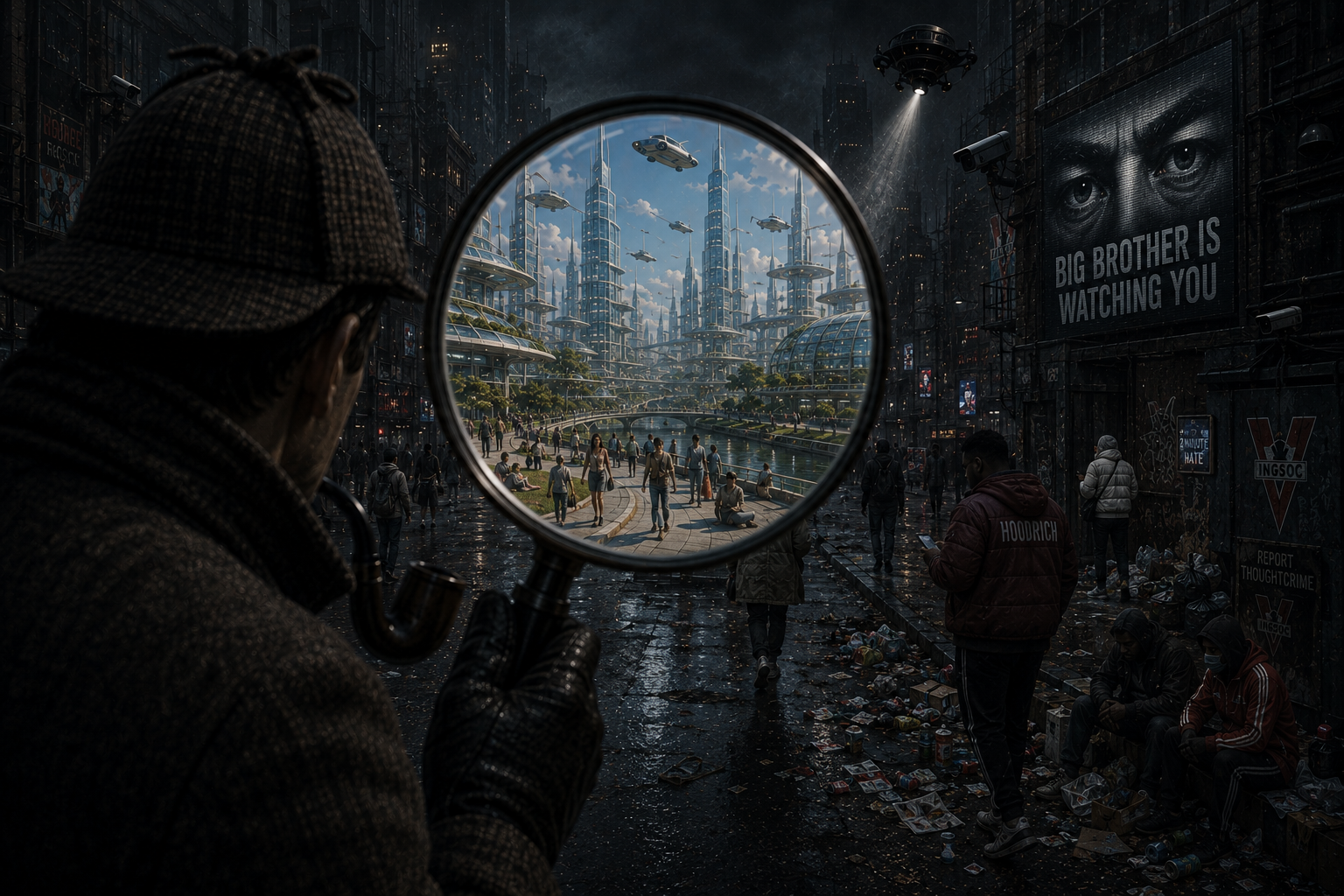

There was a time, not so long ago, when the future felt like something we could almost reach out and touch. In postwar Britain, especially during the 60s and 70s, the future wasn’t an abstract timeline of uncertainty- it was a canvas. A design challenge. A place we’d one day live. And we couldn’t wait to get there.
Ask anyone from that era what the future would look like, and their imaginations would soar: moon bases, teleporters, robot assistants, self-cleaning homes, flying cars. It wasn’t just science fiction- it was civic optimism, mainstreamed. Whether in classrooms, newsreels, or government plans, there was an unmistakable sense that progress was inevitable- not just because of technology alone, but because it was paired with the willpower to do it.
So what happened?
Why is it that in 2025, the mention of a moon base is met with eye-rolls or laughter, and ideas like high-speed trains or nuclear fusion are seen as fringe indulgences rather than national imperatives? Why has the very word future become synonymous with dread. Dread for climate collapse, war, AI doom, instead of excitement?
This isn’t just a story of cultural decline, but also of latent potential. It’s about how Britain, once a country that built the future, slowly gave up trying.
The 1960s: A Generation That Built the Impossible
In the Britain of the mid-20th century, the future wasn’t an open question, but a destination.
In this 1966 clip, a group of schoolchildren were asked what the year 2000 would look like. While some mention the atomic warfare and overpopulation problems familiar to today, others offer exciting predictions such as controlling robots on the moon and more cures for diseases. But interestingly, unlike the complainers of today, when highlighting an issue such as overpopulation, they instinctively offer solutions such as ‘living in overflows or domes under the sea’. Their response to existential threats wasn’t paralysis- it was invention.
Whilst that clip is fun to look back on, on a psychological level it’s even more interesting, as it’s proof that even children were trained to think constructively about the future. Yes, problems would arise, but we would engineer our way through them.
Compare that to today’s youth, often burdened by what’s now called eco-anxiety. It’s no wonder the dominant cultural narratives are collapse-driven. Climate change, housing crises, demographic decline- and where the '60s child might imagine a dome on Mars, today's are told to leave it to the government to fix.
What’s missing is the belief that action, especially technological and political action, can change the future.
Technological Triumphs, Then Retreat
That optimistic mindset didn’t come from nowhere. Britain was actually doing extraordinary things.
- Concorde proved supersonic passenger flight was not just possible- it was elegant, reliable, and decades ahead of its time. Flying from London to New York in just over three hours, it symbolised British ambition at its peak. Yet despite its success, it was retired in 2003 without a successor. Two decades later, we still haven't matched what Concorde achieved- proof that the limits of speed aren't technological, but political and cultural.
- British Rail’s Advanced Passenger Train (APT) was a marvel of early 1980s engineering- the first train in the world to use active tilt technology, allowing high-speed travel on curved, Victorian-era tracks without discomfort. It was decades ahead of its time. But due to political hesitation and press backlash, it was scrapped before full rollout. Ironically, the same tilting tech is now used in Italy’s Pendolinos, France’s TGV derivatives, and Japan’s express services- proving the APT wasn’t a failure, just abandoned too soon.
- Motorail allowed passengers to take their cars by train across Britain- combining the convenience of driving with the comfort and efficiency of rail. It was popular from the 1960s to the 90s, reducing road congestion and offering a low-stress alternative to long-distance driving. But it was quietly phased out in favour of car-centric policy. Today, as we face clogged motorways and push for greener travel, Motorail feels like an idea we got right, and then forgot.
- Pioneering nuclear power, opening the world’s first commercial nuclear station in 1956. Instead of scaling up, we stalled, and later sold off major projects like Hinkley Point C to French and Chinese buyers. Today, France enjoys stable electricity prices using tech we helped invent, while we face shortages and soaring bills...
These weren't visions of the future. They were the future.
Yet one by one, these initiatives were mothballed, sold off, or neglected. The Concorde is now in museums. The APT was scrapped before it matured. Motorail was dismantled in favour of ever more congested roads. Nuclear was put on the back burner. All the while, the national attitude shifted from “What else can we build?” to “What can we afford to cut?”
The Cultural Shift: From Builder to Bystander
What really happened wasn’t just policy, it was psychological. We began to believe that progress was someone else’s job. Usually someone in California or Shenzhen.
This change began in the late 1970s and accelerated through the neoliberal era of the 1980s and 90s. The narrative went from public investment in national projects to tight budgets, privatisation, and managed decline. The railways were broken up. British aerospace ambitions were curbed. Engineering, once a proud profession, became an afterthought.
During this time, the media's depiction of the future darkened, films and fiction replaced techno-optimism with dystopia. Thunderbirds became Blade Runner, Tomorrow’s World became Black Mirror, Wallace and Gromit became The Terminator.
The result? A country that once dreamed about moon colonies and fusion power now doubts and fears what technology can create.
Arthur C. Clarke and the Power of Unreasonable Dreams
No discussion about Britain’s vision of the future would be complete without paying homage to one of its greatest futurists: Arthur C. Clarke. More than just a science fiction writer, Clarke was a visionary thinker whose ideas shaped how generations imagined technology and progress.
“The only thing we can be sure of about the future is that it’ll be absolutely fantastic. So, if what I say now seems to you to be very reasonable, then I’ve failed completely. Only if what I tell you appears absolutely unbelievable, have we any chance of visualising the future as it really will happen”.
This was the mindset we lost. The belief that imagining the absurd is how you arrive at the achievable.
Clarke also championed the idea that technology should serve humanity’s higher aspirations, not merely its immediate needs or fears. His vision balanced hard science with hope, where exploration, whether into space or the mind, was central to human progress.
In today’s climate, where caution often tips toward pessimism and paralysis, Clarke’s principles feel more urgent than ever. To reclaim the future, Britain must revive it’s sense of awe and radical optimism, daring to dream the unbelievable- and then actually make it real.
Dogger Bank and the Revival of Grand Visions
And yet, not all hope is lost.
Today, the currently-scoffed-at idea of raising Dogger Bank (the shallow sandbank in the North Sea) as a man-made island or offshore city directly echoes the visions of those 1966 schoolchildren. What they described as “overflows into the sea” is no longer just fanciful imagination but could be considered as a genuine, viable solution to overcrowding.
This project stands as proof that the seeds of Anglofuturism are still in the soil- they simply just need watering.
Back to the Future: Reclaiming Lost Technologies

One of the strangest things about today’s futurephobia is how many of our boldest ideas are actually behind us.
- Super sonic passenger travel should not be impossible- we’ve already flown it.
- Sleeper car trains and Motorail aren’t dreams- we already had them.
- Nationalised, highspeed rail- we ran it.
- Fusion energy- we led the world in it.
The path forward doesn’t have to start from scratch. It can start by resurrecting the confidence of the past- and combining it with modern tools. We have better materials, better simulations, faster computers, and more precise engineering methods. What we lack is the political imagination to use them.
The Future Is Still Ours
So what happened to the future? We forgot it was ours to make.
But it’s still there, humming just beneath the surface. The tools, the knowledge, and even the legacy are in place. What’s missing is the audacity. The unapologetic belief that Britain can, and should, lead again.
Let’s teach the next generation not only how to solve today’s problems, but how to imagine beyond them.
Let’s make British innovation mean something again.
Let’s look forward.
Let’s build the future- the British way.