

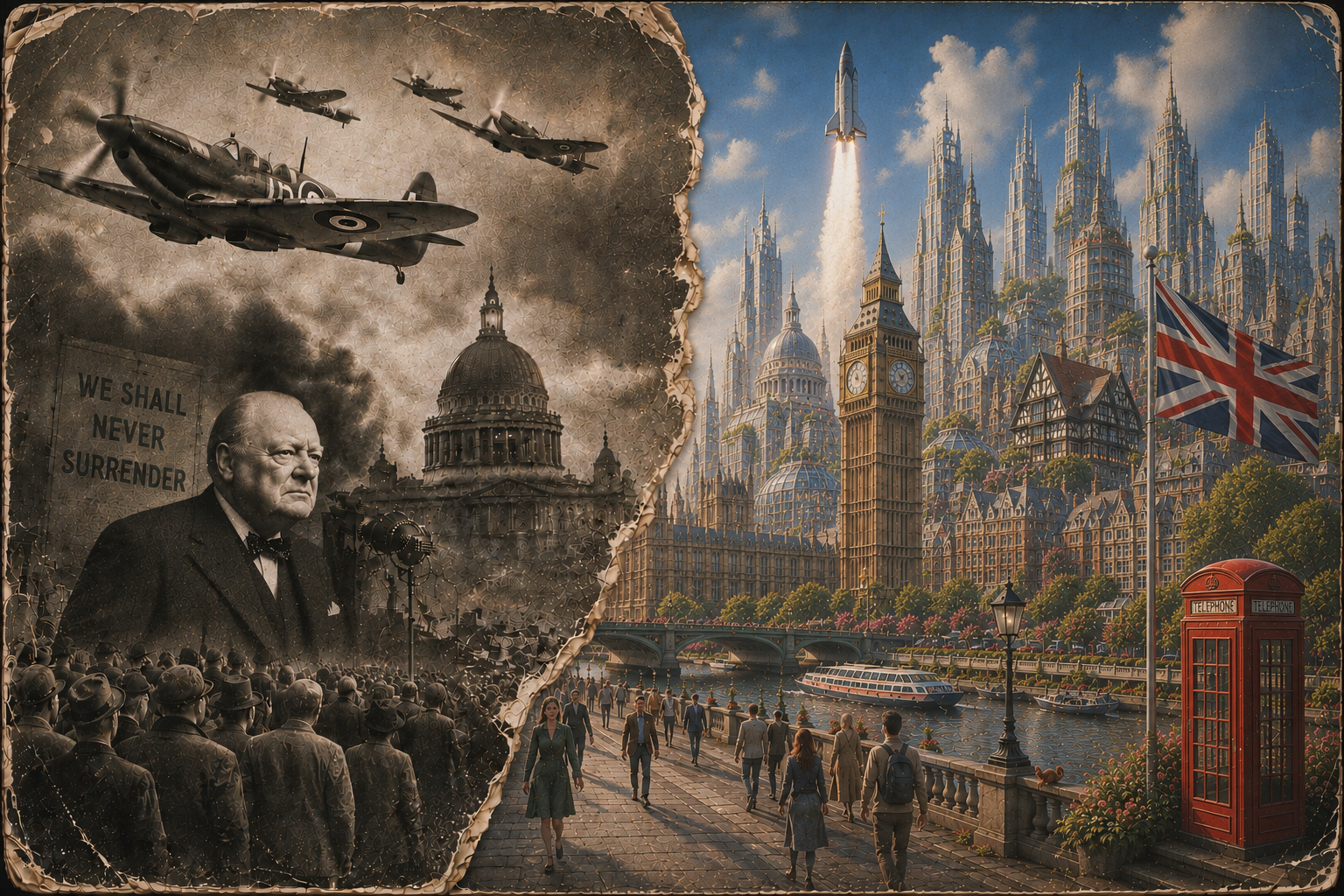

Every country runs on a story. Not history, exactly, but something selected from history, arranged with purpose, and repeated until it becomes instinct. Britain's story, for the better part of a century, was the war. Not just the facts of 1939 to 1945 but the moral architecture built around them: the island that stood alone, the ordinary people who held, the civilisation that endured. Churchill's speeches weren't just wartime communication. They were the first draft of a national mythology that would outlast the men who fought it by eighty years.
That story has run out.
The generation that remembers rationing is almost entirely gone. The children who grew up in the 1970s and after inherited the mythology without the memory, and mythology without memory is just a costume. You can wear it on Remembrance Sunday and take it off on Monday. It doesn't tell you who you are or what you're for. It doesn't answer the question that every functioning national identity has to answer: what are we building together?
The political class has not noticed, or has pretended not to. The institutional response to the fading of the war story has been to double down on it, to add more plaques and more commemorations and more television documentaries about Dunkirk, as if repetition could substitute for relevance. Meanwhile, the actual work of constructing a successor story, a story about what Britain is now and what it might become, has been left entirely undone.
Into that vacuum, nationalism has moved. Not the civic kind, but the ethnic kind, and not only in England.
Scotland and Wales were always going to be the first to feel the instability. Both nations had their own stories, older than the union, and both found those stories more available once the war mythology began to thin. The SNP didn't invent Scottish national feeling. It found it lying around and gave it a political vehicle. Plaid Cymru did the same in Wales, constructing a version of Welshness around the language, around a pre-industrial past, around everything that predates the English connection. You can object to the politics without misunderstanding the process. When the shared story goes, people reach for the nearest available alternative. In Scotland and Wales, older stories were to hand.
In England, they weren't. England is in the peculiar position of having no national story that isn't either imperial, which is now politically radioactive, or simply the British story with the serial numbers filed off. St George's Day is observed awkwardly, if at all. English nationalism has no literary tradition, no established cultural reference points, no Yeats. What it has, increasingly, is a grievance aesthetic, a sense of dispossession without a clear account of what was possessed. The far right didn't create that feeling. It inherited an empty space and furnished it badly.
The liberal establishment's reaction to the rise of ethnonationalism has been to treat it as pathology rather than symptom. There are serious people in serious institutions who have spent the last decade genuinely bewildered by the popularity of figures like Nigel Farage, by the Brexit result, by the English towns that voted Leave in proportions that suggested something deeper than trade policy. The bewilderment is not entirely dishonest, but it is entirely convenient. If you have never asked what story you're asking people to live inside, it's easy to be surprised when they start writing their own.
Brexit was a page that was almost written. There were people around the Leave campaign, and more people outside it, who sensed that the vote could be the opening of something, a new account of British agency, of democratic self-determination, of a country choosing its own direction rather than being administered from outside. That story was available. It was never told. What followed instead was three years of procedural trench warfare, a change of government that chose to narrate Brexit as embarrassment rather than mandate, and a political settlement that pleased almost nobody. The page was left blank.
The 2012 Olympics showed what was possible. For about three weeks, something strange and real happened: the country was genuinely pleased with itself. The opening ceremony, which Danny Boyle designed around the Industrial Revolution, the NHS, and the radical tradition, was not the story the establishment would have chosen and it worked precisely for that reason. It was specific. It was unashamed. It held together things that aren't usually held together, the Windrush generation and the Suffragettes and Brunel on the same stage, and people watched it and felt something that they didn't have a political vocabulary for. That feeling dissipated within months because there was no political project to attach it to.
Anglofuturism is the proposal that a story exists and that it is worth telling.
The core of it is not a nostalgia trip. The "Anglo" in Anglofuturism refers to a specific civilisational inheritance, common law, empirical thinking, a tradition of liberty that is genuinely particular to these islands and their diaspora, but the "futurism" means something. It means the inheritance is a platform, not a museum. It means the question is what Britain builds next, not what Britain used to be. The story it proposes is one of continuity and ambition together, a country that knows where it comes from and has decided to go somewhere.
This is not a story that needs to exclude Scotland or Wales. The Scottish Enlightenment, Adam Smith and David Hume and James Watt, is as much a foundation of the Anglofuturist inheritance as anything that happened south of the border. The Welsh nonconformist tradition, with its suspicion of established authority and its insistence on local self-determination, fits the common law sensibility better than most people would expect. The problem isn't that Scotland and Wales don't belong in a British story. The problem is that the British story being currently offered doesn't give them any reason to stay in it.
A national story isn't propaganda. The best ones are arguments, contested, revised, never quite settled, but arguments with enough shared premises that the contest is productive rather than merely divisive. The war story worked because it genuinely happened, because there was something real at the centre of it, because the sacrifice it commemorated was actual sacrifice. Any successor story has to have the same quality. It has to be true, or at least truer than the alternatives. Anglofuturism's claim is that the inheritance is real, that the tradition of liberty and self-government and empirical inquiry is a genuine achievement, and that a country built on that foundation has something to offer itself and the world that is worth the effort of articulation.
The elite's failure is not that it tried to tell a story and failed. It's that it stopped trying. The post-Cold War settlement assumed that the work of national identity was essentially complete, that liberal democracy plus market economics plus a vague humanitarian universalism would be enough. It wasn't. People don't live inside economic arrangements. They live inside stories. When the story empties out, they find new ones, and they don't always find good ones.
Britain's choice, as it presents itself now, is not between nationalism and cosmopolitanism. That framing is exactly wrong, and the establishment's insistence on it is exactly what keeps producing the results that baffle them. The choice is between a national story that is worth believing and one that isn't, between an account of British identity that can hold together England and Scotland and Wales and the children of Windrush and the descendants of the Norman gentry, and the various ethnic nationalisms that will fill the gap if no such account is provided.
Anglofuturism is a bet that the former is possible. It's a bet worth making.