

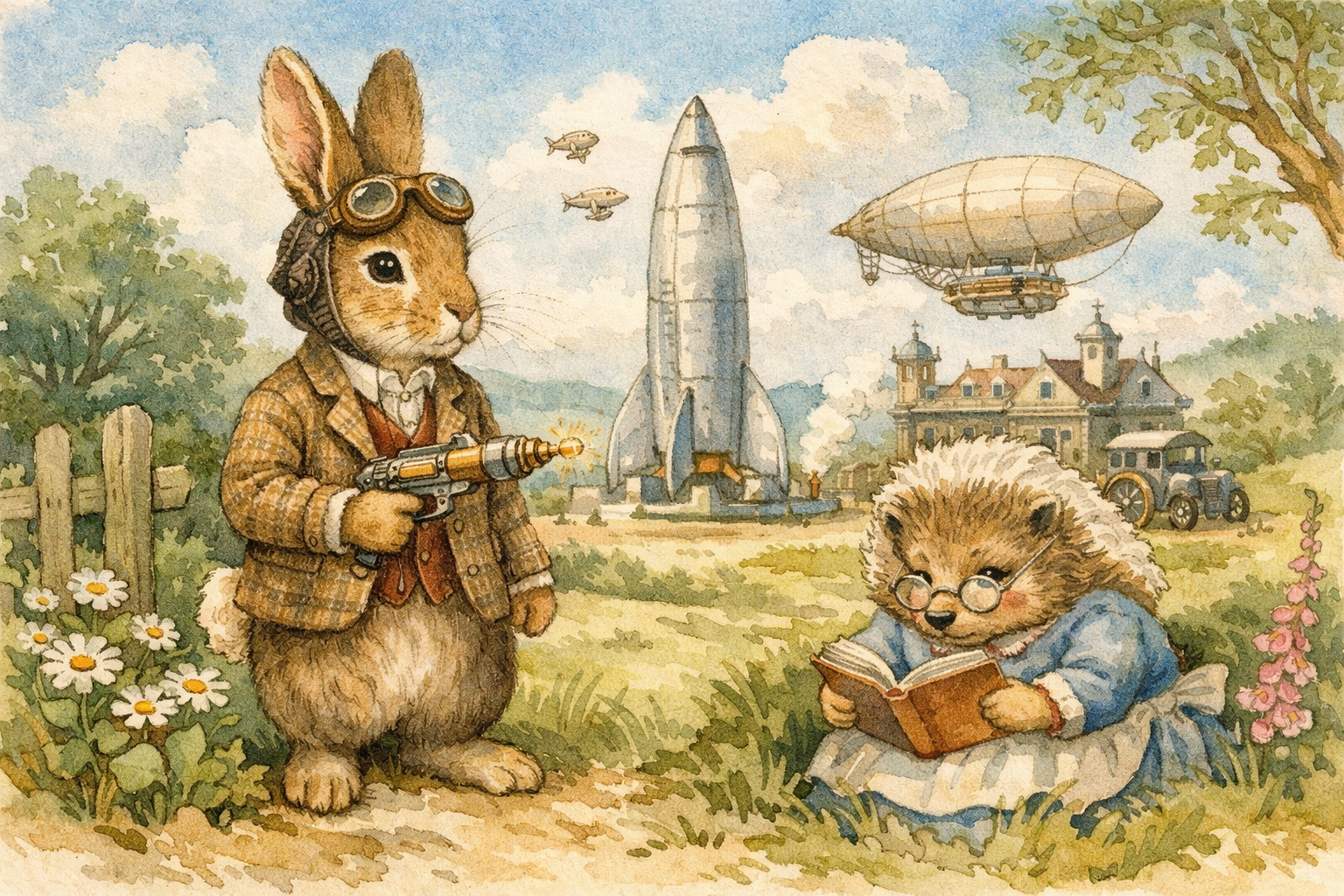

AngloFuturism draws from some of the cultural values of the pre-Modern English worldview. Bringing them into the present time, in order to provide an opportunity for a brighter future.
It is a non-political and non-nationalist movement. The Anglo relates to the English Cultural Heritage and the cultures which have their roots in it. It is not nationalist, as it exists beyond the borders of England. Including countries like Australia, Canada, USA, New Zealand and the United Kingdom.
AngloFuturism is a cultural tool to help communities to grow together, rather than apart, as we often see in our Modern technological society. The most commonly used cultural technologies today are either those grounded in Marxist thought or are deconstructivist in nature. AngloFuturism is not a technique which is rooted in these ideas. It takes the positive cultural values of pre-Modern English life and draws it forward. The love of family, community and spirituality are key elements within this cultural movement.
Instead of using a dialectic process, merging English Cultural Heritage with modern technology to develop a new cultural concept, AngloFuturism is a saddle placed on the back of the wild leviathan of technology. Rather than allowing technology to ultimately influence culture without restraint, AngloFuturism seeks to tame this beast and use it for the common good of the person, the community and the wider culture.
Only those technologies which help make these ancient English cultural values flourish are promoted. Technologies which encourage people to go outdoors and engage with their community are preferred. Whilst any technologies which foster a culture of isolation and separation between people are discouraged.
The pre-Modern English culture frames the individual as a person who exists within a network of relationships. They are dependent upon others and others are dependent on them. And so rather than prioritising an individual’s needs and passions, a person needs to also prioritise their relationships with others too.
In the pre-Modern culture, it was common for a person to be part of a local association. These associations were the bedrock of English society, without the need for a strong state. It encouraged volunteerism, which created a sense of belonging. Traditionally, local associations would have included guilds, communities and local interest groups, all centred around the local village church.
Festivals and Holy Days were key components of pre-Modern life. This makes pre-Modern English Culture local. It is not internationalists. It is fixed to a point in space and time. It is not based in a virtual world, but is grounded in the physical realm.
The meme associated with AngloFuturism is To The Stars. This provides a utopia to aim for. But we can’t get there unless we are part of a community. Individuals will not survive long term in an inhospitable space, however communities will.
English culture is built from the bottom up. It is made up of local communities connecting together. And these communities are made up of people and families, living shared lives. Historically, England was scaled up from these loosely connected communities. AngloFuturism taps into this heritage. If we want to go To The Stars, or build underwater cities, or see mini-nuclear power stations in every town providing unlimited energy, or even see a man made island on Dogger Bank, we need to come together in communities. Not around a political consensus, an elite technocracy or individualistic identities, but around a cultural movement which believes in a brighter future.
Coming together locally in the real world, and then scaling up to go To The Stars.