


Britain has spent over thirty years being poorly managed. Its infrastructure was sold, its planning system was frozen, its aesthetic standards were quietly abandoned on the grounds that no one had the authority to enforce them. The country that dug the first underground railway, that split the atom at Cavendish, that built the GPO Tower and the Humber Bridge, now debates for a decade before approving a reservoir.
Anglofuturism begins from the conviction that this isn't an economic problem or a regulatory problem. It's a problem of belief.
Anglofuturism
A vision for a technologically advanced, prosperous, and modernised Britain that blends high-tech innovation with national tradition, inspired by optimistic mid-20th-century visions and focusing on big national projects for long-term growth.
ROOTSAnglo — relating to England and the historical civilisation of Britain
Futurism — a philosophy oriented toward innovation, invention, and forward motion
The movement takes its name seriously. Anglo, because it's concerned with a specific civilisational inheritance. Futurism, because it insists that inheritance is something to build forward from, not retreat into. The combination is deliberately awkward. Futurism usually implies the erasure of the past. Tradition usually implies suspicion of the new. Anglofuturism holds that this is a false choice, and that the most consequential acts of British imagination were moments when the country's habits of mind met an ambition large enough to deserve them. The railway network. The National Health Service. The BBC, at its best. None of these were acts of nostalgia, and none were acts of rupture. They were continuations, carried out at scale.
What connects all of them is that someone, at some point, decided Britain had the authority to want something. That conviction is what's been lost. It shows up in the planning system that can't approve a reservoir, in the shopfront stripped of its original features because no one enforced the code, in the foreign policy that left Europe without a plan for what came next. The question Anglofuturism asks is not whether Britain can recover its ambition. It's whether the country still believes it deserves to.
Technological Optimism

Technology isn't neutral. Every society selects the technologies it pursues based on what it values, and those selections in turn reshape what becomes possible. Britain's current energy policy, its approach to planning, its posture toward artificial intelligence and biotechnology: all reflect choices about what kind of future the country is willing to imagine for itself. Those choices have, for a generation, been timid ones.
Concorde flew its last commercial service in November 2003. The aircraft was thirty years old, the economics had never worked without subsidy, and no successor was in development. What followed was not a reckoning with those facts but a quiet acceptance that the category was closed. It wasn't. Boom Supersonic's Overture, currently in development, is expected to carry passengers across the Atlantic in under four hours by the late 2020s. Britain, which originated the engineering, is not leading the regulatory framework that will govern it. The pattern is familiar enough to be embarrassing, and it isn't about money. France invested in Concorde under the same economic conditions Britain did. The difference was that France believed the project said something worth saying about what France was.
Space manufacturing follows the same logic. The microgravity environment of low Earth orbit allows the production of pharmaceutical compounds and fibre optic cables that can't be made on Earth. The market is early, the infrastructure is being built now, and Britain has the aerospace engineering base, through the UK Space Agency and facilities at Harwell and Westcott, to be a serious participant rather than a late customer. The Dogger Bank offers a still larger illustration. A sandbank in the North Sea, roughly the size of Wales, it was dry land until rising seas covered it eight thousand years ago. The technology to reclaim it exists; the engineering is large but not categorically different from what the Dutch have been doing since the seventeenth century. New land, sovereign British territory, available for cities or energy infrastructure. No government has seriously proposed it because no government has been thinking at that scale.
Anglofuturism thinks at that scale, and it does so from the conviction that the scale itself is the point. A society that won't attempt large things doesn't fail at large things. It simply stops being the kind of society that attempts them.
Legislated Aesthetics
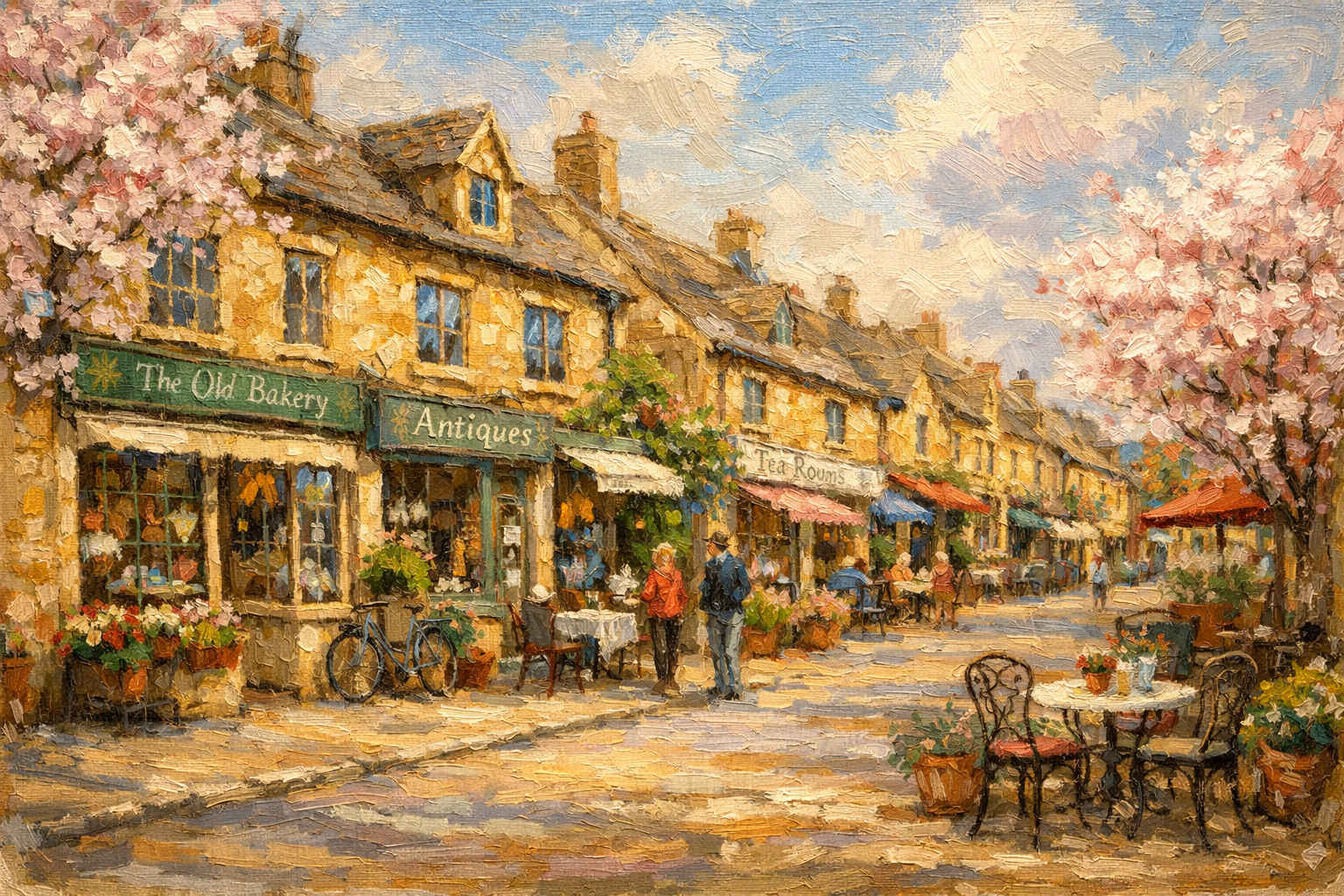
The same loss of authority shows up in the built environment, and it's worth being precise about what's been lost. It isn't beauty in some abstract sense. It's the willingness to say that beauty is a legitimate concern of public policy, that the people who live in a place have a claim on what it looks like, and that claim can be enforced.
The choice isn't between old and new. It's between care and indifference. Bath, Edinburgh and York are the most visited cities in Britain outside London not because they're old but because they're coherent: the streets have a grammar, the buildings share a language, and the public realm was made by people who believed it mattered. The traditional shopfront ripped out and replaced with tacky neon signage, the Victorian townhouse butchered into a 7 bed HMO, the new-build that looks like its from the set of the Truman Show, these aren't neutral aesthetic failures. They're the visible evidence of a planning culture that stopped believing it had the right to ask for anything better.
That belief, once recovered, has implications that run further than most people expect. If British design has a language, it should travel with British ambition. The argument that a space habitat built by British engineers should carry something recognisably British in its design, not as nostalgia but as a living tradition extending into new territory, follows from the same premise as the argument for cast iron street furniture and shopfront codes. What a society builds in a market town and what it builds in orbit are both expressions of what it thinks it's for. Anglofuturism holds that both questions deserve a serious answer.
Geopolitical Orientation
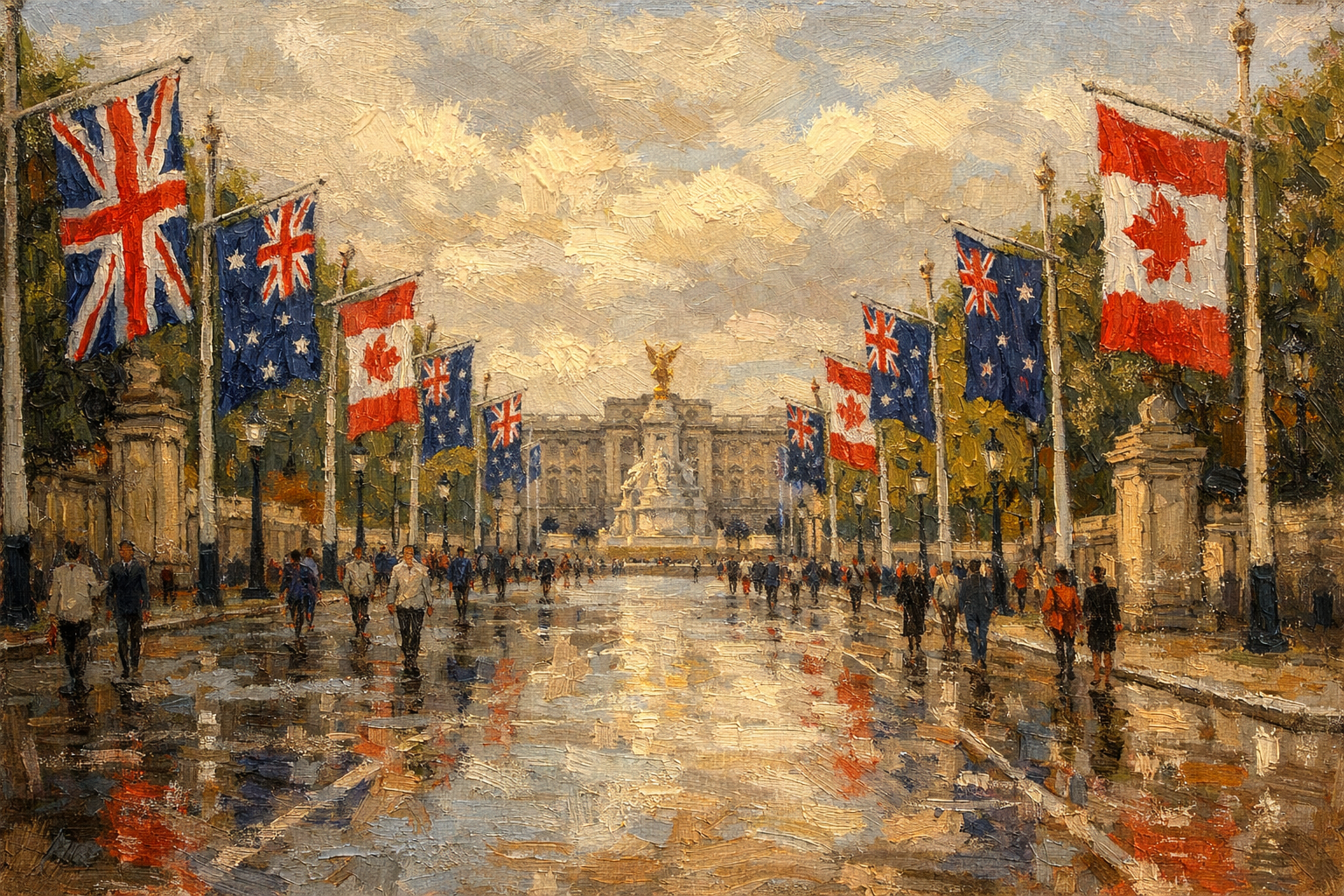
If leaving the European Union was the right call, the years that followed should have looked different. Britain had identified something real: that it had subordinated too much political authority to a supranational body whose values and trajectory weren't reliably its own. The first question was whether to leave. The second question should have been what to build next, and on that question, the country remains to this day without an answer.
However, an answer existed. The United Kingdom, Canada, Australia, and New Zealand share common law, parliamentary governance, intelligence architecture through Five Eyes, and a head of state. They're already a bloc in everything but name. CANZUK, the formal union of those four nations into a zone of free movement, coordinated defence, and harmonised trade, would give that reality institutional weight. Combined, the four represent over 135 million people across four continents, a GDP larger than every economy except the United States and China, and a set of shared institutions that took centuries to develop. That bloc could negotiate with the European Union as an equal, where Britain alone never could.
The United States remains a fellow traveller: related, indispensable, but distinct in scale and trajectory. The core four are the right starting point precisely because the shared architecture already exists. CANZUK wouldn't be building a relationship, but simply just naming one.
Environmental Stewardship

Anglofuturism doesn't oppose environmental protection. It opposes eco-austerity, the politics of managed decline in which the goal of sustainability is reached by making people poorer and inconveniencing those with no option but to accept. Achieving zero and achieving net zero are not the same thing. A country that closes its own oil fields and buys crude from Norway, the Gulf, or Iran, shipped across thousands of miles of ocean, has not reduced emissions. It's hidden them in someone else's supply chain, and called it progress. The carbon doesn't care where the accounting stops. Drilling the North Sea doesn't make Britain dirtier than the alternative. It makes the alternative honest.
Our politics treats the economy and the environment as a zero-sum trade, and it's wrong on both counts. The correct answer to energy security is advanced nuclear and selective renewables, not managed scarcity dressed up as virtue. The correct answer to biodiversity loss is targeted habitat restoration. Britain has temperate rainforest fragments in Wales and the West Country that are genuinely rare at a global scale. The red squirrel survives in remnant populations in Northumberland and Scotland. Protecting them is compatible with a high-energy, high-productivity economy. It requires seriousness, not sacrifice.
A Common Inheritance
The question of who belongs to this inheritance is one Anglofuturism has to answer directly, because a politics of civilisational confidence can become a politics of exclusion if it isn't careful about what it's actually arguing.
The argument is for integration rather than parallel existence. Communities developing without a common public culture to meet in accumulate costs that become visible only when they're expensive to address. Singapore built one of the most cohesive and prosperous societies on earth from a population that could easily have fragmented along ethnic lines, through deliberate policy and a rejection of unmanaged separation. The lesson isn't that Singapore is Britain. It's that integration is a choice, and the choice has consequences either way.
English, Scottish, Welsh, and Irish cultures are, by the measure of global population, minority cultures, with distinct languages, literatures, and ways of organising life that deserve the same preservation instinct we'd apply to any comparable tradition elsewhere. Somehow, that instinct has never quite made it home.
Those who come to Britain become British. That's not a lesser category. It's the shared civic identity that makes a country of many origins function as one, grounded in a legible set of laws, standards, and expectations that everyone is asked to meet and genuinely welcomed into meeting.
What Anglofuturism Is For
Anglofuturism is for a Britain that builds things again. That believes its best days aren't a memory to be curated but a standard to be matched. That treats the people who live in it as inheritors of something worth passing forward, and acts accordingly.
The objection that this ambition is unaffordable deserves a direct answer: it's worth asking what the lack of ambition has cost. Thirty years of managed decline has produced a country that can't build a reservoir, can't agree on a runway, and can't explain to its own citizens what it's for. That cost is real, it's ongoing, and it compounds. That bill is already due.
Anglofuturism doesn't claim the projects it proposes will be cheap or easy or without political resistance. It claims that a country without projects of this scale isn't really a country that decides its own future at all. It's a customer state waiting for someone else to decide its future- usually, in Washington or Beijing.
Britain decided its own future once before. It's time for Britain to do so again...